Showing posts with label samsung. Show all posts

Wednesday, June 16, 2010

Samsung Galaxy Beam Brings First Android-Based Pico Projector Phone to Singapore [Pico Projector]

Samsung has announced that their Galaxy Beam (formerly 'Halo') handset is headed for Singapore next month. What makes this phone so special is it that it is the first Android handset to feature a built-in DLP pico projector. Running Android 2.1, the Beam also boasts a 3.7-inch Super AMOLED display, an 8 megapixel autofocus camera with flash, and a front-facing VGA camera. Rounding out the phone are support for 7.2Mbps HSPA data, Bluetooth 3.0, 802.11n WiFi, A-GPS, and FM Radio. There's no mention of price yet but we don't expect this to have mass-market appeal. Start saving now.

[AndroidGuys via Engadget]


NOTE: Samsung Galaxy Beam Brings First Android-Based Pico Projector Phone to Singapore originally appeared on AndroidGuys.

Tuesday, March 23, 2010

Samsung outs the Galaxy S Android smartphone [Android]


We knew Samsung had something coming today at CTIA. The gigantic banner outside kind of told us that. So here it is: the Android-powered Galaxy S. There's a 4-inch Super AMOLED screen up front with an unspecified 1GHz CPU chilling inside. The Android release has been modified and uses Sammy's 'Social Hub' always-on social networking features. Swype, DLNA, and ThinkFree's MS office app are also included. We hear it will have a world-wide release later this year, but no word on specifics including price or carriers just yet. Stay tuned for some hands-on pics and our initial thoughts.

Update (Gizmodo live):

  • Android 2.1
  • 5MP camera
  • HD (720p) video playback
  • up to 16GB of onboard memory

Sunday, February 14, 2010

Samsung to Debut I8520 "Halo: Android 2.1 AMOLED Phone Tomorrow [Samsung]


Buried at the bottom of Samsung's MWC press kit was mention of an I8520 'Halo' phone. Sporting Android 2.1, a 3.7-inch Super AMOLED screen, and 720p video (to name a few), the phone will be officially revealed tomorrow.
The phone will also support an 8 MP camera, with flash; DivX/Xvid playback; Bluetooth 2.1; 802.11b/g/n WiFi; GPS; and 16GB storage.
There's a 'Specialized Projector UI' feature in there too, but indications are it's probably just TouchWiz. The European release date period is Q3 2010, with no word on a U.S. release date at this time.
[Gizmodo via Samsung via Engadget]

Samsung Waves Hello To Wave S8500 Smartphone With Bada OS and SUPER AMOLED Screen [Samsung]


It was hardly a well-kept secret by any stretch of the imagination, but at MWC Samsung's Wave S8500 has raised its head. It's running the new Bada OS, and has one of those 3.3-inch SUPER AMOLED screens we saw before.
The SUPER AMOLED screen is a 3.3-inch capacitive job, with an 800 x 480 resolution—not shabby, to say the least. The larger 3.5-inch display of the iPhone for example has 480 x 320 pixels. Anyway, it's also the first phone to have Bluetooth 3.0, as rumored yesterday, using the 802.11 protocol for transferring data at around 24Mbps. Speedy-fast, you could say.
A 1Ghz processor and 2GB of memory has been popped into the typical-looking Samsung exterior, along with a 5.0-megapixel camera (with autofocus and flash), capable of shooting video at 720p. Wi-Fi, GPS and HSDPA connectivity round it off.
Going back to the Bada OS, this was first unveiled in November but now we know that it's compatible with Samsung's TouchWiz 3.0 interface (a step up from the 2.0 Plus, which was seen on the leaked Monte last week).
It'll be out in April, and while I've never particularly been impressed by a Samsung phone before (far from it, in fact), the Wave does have some interesting specs—like that AMOLED display. Wait and hear our verdict when we get hands-on with it, because as you know...things don't always turn out like the marketer boasts.
[Gizmodo]

Saturday, February 13, 2010

Samsung: Yep, we’re working on a Chrome OS netbook [Chrome OS]


In not-too-surprising, yet good-to-know-for-sure news, it seems that Samsung is indeed working on a netbook designed around Chrome OS. Now, what exactly that comprises I can’t tell you — my guess is they’re really just getting a cheap netbook ready to go with whatever Google announces when Chrome OS hits prime time. Or maybe they’ll use one of those neat (useless) transparent ones?
The specs are nothing crazy: 3G, 2GB of RAM to start, 64GB or more of SSD storage, probably a 10.1″ screen, and a nice long battery life. The chipset and processor weren’t disclosed, but the source is suggesting a 1.5GHz Snapdragon. I wonder about that — I wouldn’t be surprised if there are some curveballs in there. Dual Snapdragons, for instance, or a dedicated GPU like the iPad. It’s actually very similar to this speculative post here, except without a price, which makes it much easier to swallow.
Guess we’ll find out… not soon. It’s not clear when they’ll be making the real announcement, and at any rate we’ll probably hear from Google first.
[CrunchGear via Tom's Hardware]

Thursday, February 4, 2010

Samsung’s Android 2.1 Powered M100S Debuts in South Korea [Android]


Samsung has announced another new Android handset, this one destined to stay back home in South Korea. Like most everything else we've seen from the handset maker, it's a touch-only phone. Dubbed the SHW-M100S, this marks the first Android 2.1 to come from Samsung.
The specs are right in line with other recent Android handsets. It features a 3.7-inch AMOLED display, 5 megapixel camera with 720p support, WiFi (802.11n), GPS, T-DMB, DivX support, and a 3.5mm headphone jack. There's an 800MHz processor under the hood and the UI is a new version of TouchWiz. Based on the few pictures we've seen so far, we're fans of the evolved interface. There's no sign of any silly 'cubes' to be found!

Pricing has not been determined as of yet. Look for the M100S next month (March) on SK Telecom.
[AndroidGuys via Samsung Hub]

Monday, February 1, 2010

Samsung Producing First Integrated Touchscreen AMOLED Panels Starting Next Month [OLED]


Samsung Mobile Display has announced that they're going to begin mass production of the world's first 3.3-inch touch-embedded AMOLED panels next month. That means goodbye heavy glass display, and hello thinner, lighter, brighter phones.
The technology Samsung has developed places .001mm thin touch sensors on-cell on a 3.3-inch WVGA AMOLED, between the panel's substrate and the bottom polarizer film. The result is that you don't need the touch-sensing glass panel that currently sits above your phone's display anymore. The technology could also be integrated into cameras to provide a brighter display and/or longer battery life.
We've been enamored with AMOLED before, but this is the first time we've seen such a practical application hit mass production. Exciting! More so when we actually start to see some of these products hit the market—and see how much they cost.
[Gizmodo via Korea IT Times via OLED Info via Engadget]

Saturday, December 19, 2009

Samsung Bada screenshots hit the web, but what’s with the Series 60 font?


Hey, good on Samsung for trying to make their own OS. I'm sure it will be wonderful for them. It saves them from having to, I don't know, use Android? But what's with all the Nokia Series 60 font usage in the UI?

These screenshots, which are floating around right now, show some of the UI elements of the new OS, Bada. The font they're using is approximately (or exactly, I'm not a font scientist (fontographer?)) the same font used on most Series 60 Symbian phones.

Tuesday, December 15, 2009

Scandinavia gets world's first LTE network; U.S. still puttering at 3G


In a move that bodes well for that website to download a little faster on your cellphone, Scandinavian service provider TeliaSonera just switched on the world's first Long Term Evolution (LTE) cellphone network in Stockholm and Olso. Right now the only product capable of receiving the beefy 4G bandwidth of LTE is a Samsung Kalmia modem USB dongle (Model GT-B3710), but handsets are planned for the New Year. Theoretical download speeds are said to be 10 times 3G, or 100Mbps, though realistically it would only be a fraction of that (still way better than 3G).

It's great to see LTE tech finally move out of the 'buzzed about on the Internet and at trade shows' phase and into the 'it's here' stage, though predictably it didn't happen in the U.S. (not exactly know for its innovative cellphone networks). It's not all bad news stateside, though: Sprint has been slowly but steadily expanding its 4G network, based on WiMax technology, and Verizon and AT&T have plans to deploy LTE networks next year and beyond. Maybe then we'll finally be able to use SlingPlayer for iPhone outside of a Wi-Fi hotspot.

[DVICE via TeliaSonera, via Engadget]

Tuesday, November 24, 2009

Swype vs QWERTY: FIGHT!!!!! [Touch Screen]


QWERTY is pretty much the king of smartphone text input. But there's a new challenger on the horizon. It's called Swype, it works with one-hand input and, yeah, it is pretty fast.
Yes, the first thing you may notice is that Swype technically uses a QWERTY layout. But instead of pushing each key individually, you drag your finger from letter to letter.
It's tough to tell if the speed gains are legitimate, given this video has been created by the Swype camp. I will say, however, given that this demo is one hand vs. two, the technology certainly holds its own. What do you think? Would you be willing to part with traditional QWERTY to spell words through nonsensical doodles?
Swype will debut in Verizon's Samsung Omnia II arriving early next month before making its way to an unnamed Android phone next year.
[Gizmodo via Swype via TechCrunch via OhGizmo]

Thursday, November 12, 2009

Samsung’s first Bada OS handset leaks out

samsung-bada-leak

In case you haven’t heard, the other day Samsung announced Bada, its own smartphone OS — complete with app store — that it plans to pit against the iPhone and the entire Android line-up. Set to arrive in Q1 2010, not much is known about Bada other than that it features an intuitive touchscreen-based UI and will, for the most part, take the place of all Symbian S60 handsets offered by the Korean company. The handsets that will debut running Bada are also a mystery, but our Dutch friends over at Mobile Phone Helpdesk Europe were sent in a tip, and the handset you see rendered above could be amongst the very first. The fact anyone with the slightest Photoshop skills could whip this up aside, let’s assume for a minute what we’re looking at is real. Are you feeling it or not?

Tuesday, November 10, 2009

Did Samsung Just Announce Another Mobile OS? [Samsung]


They're calling it 'Bada,' which means ocean in Korean. And it's got an SDK! After sifting through hundreds of words of deliberately vague press release, this is all we really know about Samsung's new mobile OS. Well, almost.
Samsung is as aware as any company of just how many smartphones OSes there are in the world, since they license almost all of them, from Windows Mobile to Symbian to Android. Throwing another OS into the mix seems like it might confuse things, but at first glance, that's exactly what it looks like they're doing:
In order to build a rich smartphone experience accessible to a wider range of consumers across the world, Samsung brings bada, a new platform with a variety of mobile applications and content.
So, a new OS with an emphasis on apps. But why the awkward language about 'smartphone experiences' and 'accessibility?' On the project's website, Samsung's a little more clear:
More and more people want rich and connected application-experiences that are currently available only for smartphone consumers. Samsung has developed bada to make these exclusive smartphone experiences available to everyone.
Ah! So it's probably not a full-fledged smartphone OS, but a feature phone OS with an SDK. Samsung is a huge company, so this can't be ignored, but it doesn't mean that smartphones are about the get more confusing. If anything, it means that feature phones are about to get better.
Or not at all! We won't know for sure until Samsung stop being cryptic for sport, or whatever it is they're doing here. [Samsung]
Samsung Launches Open Mobile Platform:
Samsung bada – The Next Wave Of The Mobile Industry
Developers get the chance to create mobile applications
for millions of new Samsung handsets

November 10th, 2009, Seoul, Korea – Samsung Electronics Co. Ltd., a leading mobile phone provider, today announced the launch of its own open mobile platform, Samsung bada [bada] in December. This new addition to Samsung's mobile ecosystem enables developers to create applications for millions of new Samsung mobile phones, and consumers to enjoy a fun and diverse mobile experience.
In order to build a rich smartphone experience accessible to a wider range of consumers across the world, Samsung brings bada, a new platform with a variety of mobile applications and content. The name ‘bada', which means ‘ocean' in Korean, was chosen to convey the limitless variety of potential applications which can be created using the new platform. It also alludes to Samsung's commitment to a variety of open platforms in the mobile industry. Samsung bada also represents the fresh challenges and opportunities available to developers, as well as the entertainment which consumers will enjoy once the new platform is open.
Based on Samsung's experience in developing previous proprietary platforms on Samsung mobile phones, Samsung can create the new platform and provide opportunities for developers. Samsung bada is also simple for developers to use, meaning it's one of the most developer-friendly environments available, particularly in the area of applications using Web services. Lastly, bada's ground-breaking User Interface (UI) can be transferred into a sophisticated and attractive UI design for developers.
Samsung will be able to expand the range of choices for mobile phone users to enjoy the smartphone experiences. By adopting Samsung bada, users will be able to easily enjoy various applications on their mobile.
Samsung bada also offers an easy-to-integrate platform for mobile operators so that mobile operators can provide unique and differentiated services to their customers. Samsung established its mobile application ecosystem through the launch of Samsung Mobile Innovator in 2008 and the Samsung Application Seller Site followed by Samsung Application Store as another key element of this offering.
Dr Hosoo Lee, Executive Vice President and Head of Media Solution Center at Samsung Electronics said, 'By opening Samsung's mobileplatforms we will be able to provide rich mobile experiences on an increasing number of accessible smartphones.' He added, 'bada will be Samsung's landmark, iconic new platform that brings an unprecedented opportunity for operators, developers and Samsung mobile phone users around the world.'
The official website (www.bada.com) will open on November 10th and will feature a range of information on bada including updates onproduct launches, features, and event notices. Samsung will also host an official launch event for bada in London, UK in December and will also unveil its bada software development kit (SDK) to developers for the first time on this date.


 [Gizmodo]

Sunday, November 8, 2009

Samsung's New Ultra Slim 30-Nanometer Flash Memory Chips Will Cause Gadget Shrinkage [Flash Memory]


With stacks of eight being only 0.6mm thick, Samsung's new 30-nanometer NAND chips are practically anorexic, but for once that's a good thing. Thinner chips like these could bring smaller gadgets and hopefully also lead to lower SSD prices.
According to Samsung, their new chips are actually the slimmest ever and '40% thinner and lighter than a conventional memory package.' Whether those details are true or not, I look forward to seeing them hit the market and start slipping into newer, smaller gadgets.
[Gizmodo via Information Week via Engadget]

Friday, October 16, 2009

Samsung Screen Resists Merciless Hammering Without a Scratch [Displays]


Color me impressed. Watch as this guy relentlessly beats this new Samsung flexible screen with a mallet. Amazingly, the 2.8-inch active matrix OLED—only 0.01 ounces, and 20 micrometers thick—keeps running happily, without a single scratch.
[Gizmodo via Gadget Lab]

Wednesday, October 7, 2009

Samsung takes a moment to announce the Android-powered Moment


Hot off the presses! Samsung has announced a new Android-powered phone: the Moment. The new Android-powered Samsung Moment is the first Sprint phone to use Samsung's new 3.2' AMOLED touchscreen display and will feature a landscape sliding QWERTY keyboard. And it's not priced all that bad either.

It's got a 3.5-mm headphone jack and SDHC expansion (compared to an awkward mini-USB combo and a microSDHC), but it's also significantly thinner and loses the G1's chin. It's got a 3.2MP camera on the back.
Unlike the Motorola Cliq or HTC Hero, Samsung hasn't messed with the stock Android interface very much at all, merely sprinkling in some carrier-specific widgets like Nascar, Sprint Navigation and Sprint TV, which actually works quite well.


Specs:
* 3.2-megapixel camera with flash and camcorder with auto-focus
* Stereo Bluetooth® 2.0 wireless technology
* Expandable memory up to 32GB
* Sprint TV® with live and on-demand programming
* NFL Mobile Live and NASCAR Sprint Cup MobileSM
* Easy access to social networking sites, including Facebook®, Flickr® and TwitterTM
* Media player with 3.5-millimeter headphone jack
* Visual voice mail for quick and easy access to specific voice mail messages
* Access to personal and corporate email through Active Sync


Monday, October 5, 2009

Samsung Behold II, TouchWiz Wonder for T-Mobile


If you happen to leave in the USA and looking for a new Smartphone, here you are the Samsung Behold II, an Adnroid Powered device with 5Mpix AF camera module, a 3.2” AMOLED screen, WiFi, Bluetooth 2.1 and microSD card.

But the most interesting part of this release is the portage of Samsung TouchWiz 3D Interface to android, a nice alternative to what HTC is now offering on its Smartphone line-up.

Monday, September 28, 2009

Samsung SCH-W880: The Digital Camera that Can Call [Digital Cameras]


You don't fool us, Samsung. With its camera mode dial and dedicated shutter button, your 12 megapixel Samsung SCH-W880 with HD video recording, and 3x optical zoom looks a lot more like a real compact camera than a phone.

Apart from its clearly camera design, the Samsung SCH-W880 comes loaded:
• 3.3-inch AMOLED WGA screen.
• UMTS/HSDPA connectivity.
• Wi-Fi
• GPS
• Bluetooth
• Slot for microSD cards.
• HD video at 30fps
• Macro mode.
• Xenon flash.
We haven't tried yet, but this looks like the first cameraphone that can actually satisfy the photographer/Peeping Tom in us. [Gizmodo via Samung Hub via HDblog via Engadget]

Tuesday, September 22, 2009

Samsung Opens the Door to PC-Level Performance on Mobile Devices with 1GHz Low-power Application Processors


There is hope my friends, yes there is! Samsung announced today two new 1GHz ARM Cortex A8 application processors the S5PC110 and S5PV210 capable to able High Speed 3D graphic rendering video as well as support of both HD Videos and the possibility to output video with HDMI 1.3 interface…

These 2 new CPU are good news, finally HTC will be capable to propose less sluggish device from now on! If only they could focus on ROM optimization rather than wasting their time on UI Eyes candy.

Seoul September 22, 2009 -- Samsung Electronics Co., Ltd., a world leader in advanced semiconductor solutions, today introduced two new 1GHz ARM® CORTEX™-A8 based application processors, the S5PC110 and S5PV210, for advanced mobile devices at the sixth annual Samsung Mobile Solutions Forum held at the Westin Taipei Hotel. The S5PC110 is targeted for small form-factor connected devices such as multimedia intensive smartphones, while the S5PV210 is aimed at portable computing devices such as netbooks that demand high performance and design flexibility.


“More and more, user generated contents currently accessed via the PC will be spread to mobile devices,” said Dr. Kwang Hyun Kim, senior vice president, strategic marketing team, System LSI Division, Samsung Electronics. “PC-level performance with lower power consumption will become mainstream requirements for advanced mobile devices. Samsung developed S5PC110 and S5PV210 application processors to satisfy these conflicting requirements to enable a new level of user experience not previously possible.”


Both the S5PC110 and S5PV210 ensure longer battery life for mobile devices running on standard size batteries through a variety of low power technologies, including the use of a 45-nanometer (nm) Low Power fabrication process and intricate low power architectures. Each of these application processors comes with 32KB data and 32KB instruction caches, and is equipped with a 512KB L2 cache. With the 1GHz clock speed and large size L2 cache, these processors enable real-time applications such as web browsing and user interface (UI) to run smoothly with a fast response time.

High speed 3D graphics rendering and high resolution video support are two key differentiating features for advanced mobile devices. Both the S5PC110 and S5PV210 are equipped with a powerful built-in 3D graphics engine to support sophisticated 3D UI and high-caliber games. In addition, the two processors integrate a1080p full HD codec engine that supports 30fps full HD video playback and recording. A built-in HDMI1.3 interface allows output of captured or downloaded mobile multimedia contents to an external high definition digital display.

These two new application processors also feature a wide variety of interfaces and peripherals to maximize design flexibility and reduce system BOM cost of targeted mobile devices. In particular, a high speed USB 2.0 host interface is integrated for hosting various USB peripheral devices.

Targeted for small form factor mobile devices, the S5PC110 is housed in a 0.5mm pitch, 14X14mm2 FBGA package that allows package-on-package vertical stacking of low power, multiple chip package (MCP) memory such as OneDRAM™, mobile DDR and LP DDR2, greatly reducing the overall foot print of the memory and processor combo.

Designed for portable computing applications, the S5PV210 is packaged in a 0.65mm pitch, 17X17mm2 FBGA package with a high performance 2-channel 32-bit DDR2 memory interface that is essential for computing devices.

Customer samples of both products will be available in December, 2009.
...

Monday, May 19, 2008

סמסונג תציג טלויזיה בגודל 82 אינץ'

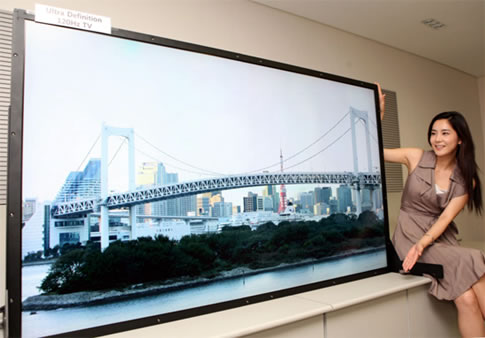
הטלויזיה החדשה של סמסונג אשר תוצג בתערוכת SID 2008 היא ה-LCD הראשונה בגודל זה אשר כוללת טכנולוגיה של Ultra Definition או הפרדה גבוהה במיוחד. ההפרדה של טלויזיה זו היא 3840X2160. בנוסף קצב ההתחדשות של המסך (Refresh Rate) הוא 120 הרץ שזה כפול מרוב מסכי ה-LCD היום. המסך מואר מאחור ע"י לדים בצבעים אדום, ירוק וכחול מה שמביא את ספיגת הצבעים (Color Saturation) לרמה מאוד גבוהה - 150%, מבוסס על סטנדרט NISC ל100% ספיגה.

בנוסף משחררת סמסונג גם מסך דומה בקצב 60 הרץ אך מצויד במערכת רב-מגע (Multi-Touch) שהוא הגדול מסוגו כיום עם מערכת מגע. מטרתו להחליף לוחות מחיקים ומקרנים במערכת החינוך.

אולי התקדמויות אלה יוזילו את המסכים הביתיים כדי שאוכל לקנות טלויזיה ב-HD לפליי-סטיישן החדש שלי, בלי שהמצפון יציק לי יותר מדי.